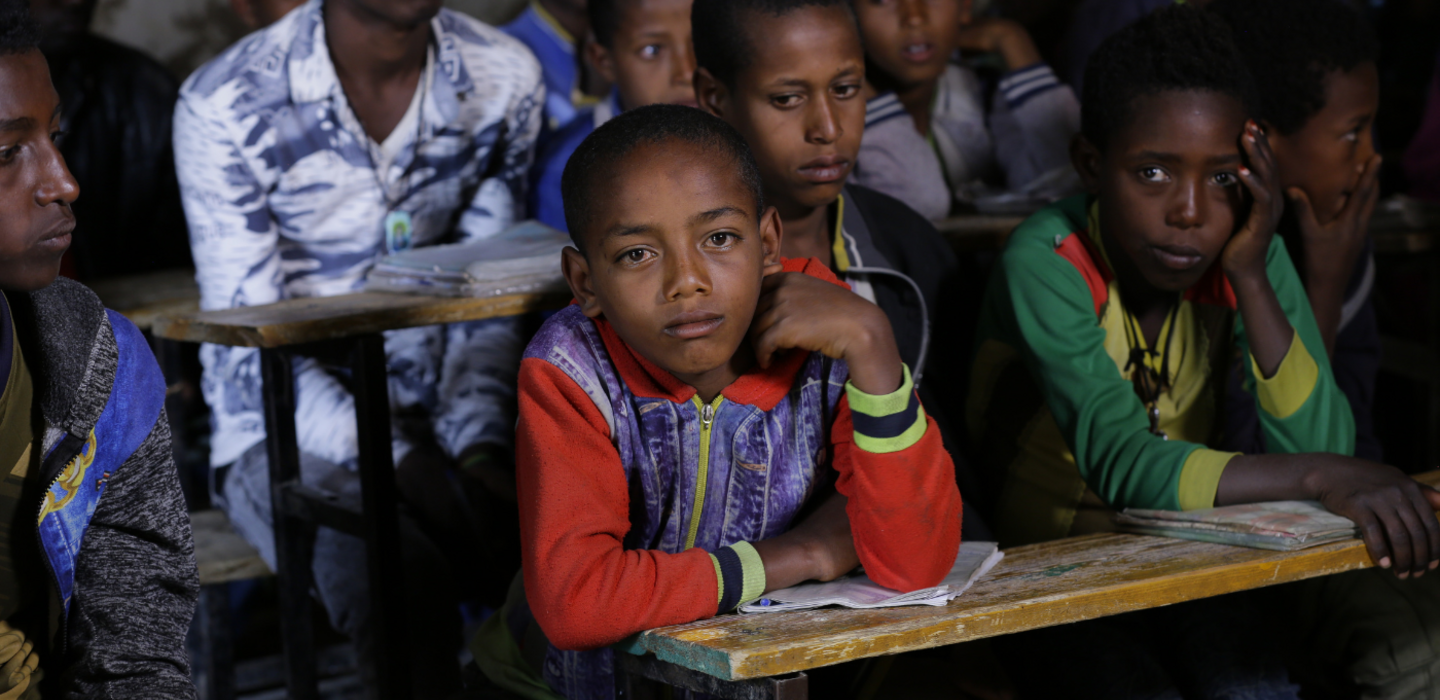
First-grade students in Ethiopia’s Amhara region open their textbooks for a lesson on the parts of the body. Colorful illustrations show how the students’ noses help them smell fragrant flowers and how their eyes help them look far into the distance, as well as see their futures.
Children bear the greatest burden of infection, but the cleaner their faces are, the less likely they are to contract the disease.
Following the textbook’s lead, their teacher asks, “What’s the difference between a clean face and a dirty one? Why is personal hygiene so important?”
Knowing the answers can make an outsized impact on the lives of children in Amhara, the region with the world's highest rates of trachoma — the leading cause of infectious, yet preventable blindness. Children bear the greatest burden of infection, but the cleaner their faces are, the less likely they are to contract the disease, which spreads through normal physical contact with other people or by eye-seeking flies.
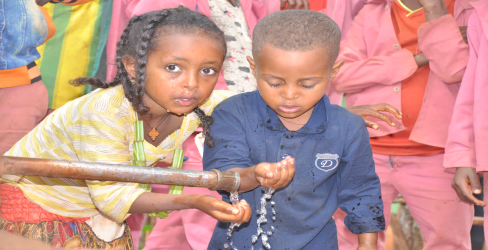
Schools are on the front lines of the effort to eliminate trachoma as a public health problem. Since 2017, Ethiopian educators have been teaching new and updated lessons about the disease to first- through fourth-grade students through the School Trachoma Program, a curriculum developed by The Carter Center and the Amhara Bureau of Education and funded in part by Lions Clubs International Foundation.
Until recently, that curriculum was taught through separate reference documents and learning aids. Now, trachoma education is part of the textbook, ensuring sustainability of preventative trachoma education for the most at-risk population.
“Anytime there is a lesson relevant to trachoma, like how to wash or use a latrine, the information is included in the text,” said Eshetu Sata, trachoma program manager for The Carter Center in Ethiopia. “It’s all included so teachers don’t need reminders, and they don’t need to prepare separate lesson plans.”
Once included as separate materials, such as flip charts, trachoma lessons are now included in textbooks in Amhara.
As students age, the lessons become more complex. By fourth grade, students understand that trachoma doesn’t just affect an individual but that person’s entire family and community. They learn the science behind the infection, as well as what treatment options are available in their villages.
“In grade one, students may not be able to fully understand the information, but by grade four, they know what trachoma is and how to treat it,” Sata said. “The teachers are seeing a difference.”
The success of this program has also led to a pilot project for kindergarten students in 60 schools, with plans for expansion. Students can then bring what they’ve learned back to their families, helping to multiply prevention education and keep everyone healthy. Coupled with more than 228 million antibiotic treatments administered in Amhara since 2001, trachoma’s hold on the region is weakening.
Sixty schools in the region are piloting trachoma education in kindergarten so even the youngest schoolchildren can learn about the importance of washing their hands and faces to avoid contracting the disease.
“Years ago, it seemed like everyone had trachoma in Amhara, women and children especially,” said Kim Jensen, an associate director in The Carter Center Trachoma Control Program. “We’ve seen tremendous progress. More importantly, we can now hope that, while these future generations of children may know about trachoma because of the lessons they have learned in school, they won’t be impacted by trachoma like their mothers and grandmothers were.”
Since 1999, support from the Lions Clubs International Foundation has been instrumental in the success of The Carter Center’s Trachoma Control Program in Amhara, which is the first region in Ethiopia to take trachoma intervention activities to full scale, reaching nearly 22 million people.
Andre Gallant is the lead writer for The Carter Center.
